Showing posts with label Human Rights. Show all posts

Thursday, 22 November 2018

Human Rights Violation In Iran Condemned By The Third Committee Of The UNGA

Human rights violation in Iran condemned by the Third Committee of the UNGA

For 4 decades, the civilized world has monitored the human rights violations committed by the mullahs’ regime. There has not been a day without human rights abuses in Iran in that period. The Iranian and international human right activists, writers, and NGOs have never been ignorant of that.
The cases of human rights violation under the ruling mullahs include torture, rape, juvenile execution and of course torture and execution of political prisoners, dissidents and minorities, etc.
Being systematic is the remarkable characteristic of these inhuman actions. Accordingly, the UN General Assembly has paid special attention to the human rights abuses in Iran, issuing 65 resolutions in condemnation so far. The last one adopted was on Nov. 15, 2018.
Human rights violation in Iran condemned by the Third Committee of the UNGA
Following the human rights violations in Iran, the General Assembly has dedicated a special rapporteur to the situation of human rights in Iran from 1984.
The Iranian regime has refused to issue them the visa to enter the country except for one case.
The General Assembly’s Human Rights Committee adopted the resolution by a vote of 85-30, with 68 abstentions, after reviewing detailed reports filed by its special rapporteur. It is virtually certain to be approved by the 193-member world body next month.
In the resolution, the committee expressed its concern over the high number of executions, dire prison conditions, torture and arbitrary arrests in Iran.
Referring to the reports of the United Nations Secretary-General and the Special Rapporteur on Human Rights on Iran, the resolution states, that the Iranian government has increased suppression of protesters, journalists and social network users over the past year.
The representative of the United States urged Iran to grant unrestricted access to the Special Rapporteur.  She condemned the crackdown on the nationwide protests voicing concern over the detention of 800 protestors.
November 15, 2018 – Ottawa, Ontario – Global Affairs Canada The Honorable Chrystia Freeland, Minister of Foreign Affairs, issued the following statement welcoming today’s adoption of the resolution on the situation of human rights in Iran in the UN General Assembly’s Third Committee, during the assembly’s 73rd session:
“The adoption of this UN resolution by countries from every region of the world sends a strong message to the Iranian regime that it must respect human rights.
“It also voices the support of Canada and the international community for the people of Iran in their struggle to enjoy the rights and freedoms to which they are entitled. Canada urges the Iranian regime to address the grave human rights concerns raised in this resolution.”
Considering the regime’s other crimes and repressive policies which the resolution fails to enumerate, including systematically assassinating opponents abroad, and depriving the people of Iran of their rights to decide their country’s fate, to enjoy the rule of law, to have access to fair trials, to have free access to information, and to form independent syndicates and unions for workers, students and government employees, it is safe to say that the Iranian regime is the most ruthless, aggressive violator of human rights in the world today.
“Condemning the systematic and gross violations of human rights by the theocratic regime ruling Iran, the UN resolution once again confirmed that the regime blatantly tramples upon the Iranian people’s most fundamental rights in all political, social and economic spheres,” said Mrs. Maryam Rajavi, the President-elect of the National Council of Resistance of Iran, in welcoming the 65th UN resolution condemning human rights abuses in Iran.
Maryam Rajavi reiterated, “The most vivid example of grave violations of human rights in Iran is the 1988 massacre of political prisoners perpetrated by the regime’s key institutions and leaders, who are still in power, still defend this crime, and remain immune from punishment.
The world community faces a monumental test in investigating and prosecuting those responsible for this great crime against humanity.”
The adoption of the 65th UN resolution, condemning abuses in , once again confirms that the regime blatantly tramples upon the Iranian people’s most fundamental rights in all political, social and economic spheres.
471 people are talking about this
The world community must refer to the dossiers of the regime’s crimes to the UN Security Council and recognize the right of the people of Iran to resist against so inhuman a regime.

Related

UN Special Rapporteur:  An Upsurge In Executions And Suppression In Iran
UK’s Religious Leaders Condemn Iran’s Human Rights Abuses
Human Rights Abuses In Iran, Against The Most Basic Rights
Violation Of Human Rights In Iran

United Nations-Geneva: Speech By Dr. Alejo Vidal-Quadras At The Conference On Human Rights In Iran

Thursday, 25 October 2018

UN Expert Says Human Rights Should Be At The Heart Of The Response To Challenges Faced


Mounting challenges in Iran should be met by a constructive response which places international human rights law at its heart, said Javaid Rehman, the new Special Rapporteur on human rights in Iran.
While noting “potentially diverging views, including on the mandate itself”, the Special Rapporteur said he hoped to “build on the cordial cooperation” extended to him thus far through “constructive engagement” with Iran, and hoped to visit the country.
Presenting his first report to the General Assembly following his appointment in July, the Special Rapporteur welcomed the decision by Iran to amend its drug-trafficking law which led to a marked reduction in the number of those executed for drug offences.
The Special Rapporteur also expressed alarm that Zeinab Sekaanvand was executed on 1 October, noting that “she was the fifth juvenile offender executed this year” following a trial raising numerous due process concerns. He also recalled that there were numerous juvenile offenders currently on death row in Iran, including Mohammad Kalhori, Mehdi Khazaeian, Mohammad Haddadi, Pouria Tabaei, and Saleh Shariati. The Special Rapporteur appealed to the Iranian authorities to abolish the practice of sentencing children to death, and to commute all death sentences issued against children in line with international law.
“The challenges facing people in Iran these past months has been illustrated by numerous protests across the country,” the Special Rapporteur said. He said that the protests were fuelled by discontent relating to the enjoyment of economic and social rights and urged “the Government to both address the grievances underlying the protests, and also safeguard the right to freedom of association and assembly”. “In challenging times, the right to freedom of opinion, expression, and access to information are all the more important.” he added. 
Explaining that he will seek to address economic and social rights in the course of his mandate, the Special Rapporteur said he also intended to assess the possible negative impact of sanctions on the enjoyment of such rights.
He further described a number of long-standing issues of concern which he will seek to address including with respect to the right to life and to a fair trial; the recent arrests and treatment of human rights defenders, other civil society actors, and lawyers; and the rights of women, foreign and dual nationals, and groups in vulnerable situations in Iran.  The Special Rapporteur, in particular, expressed concern and alarm at the treatment of religious and ethnic minorities.

Thursday, 11 October 2018

The Death Penalty In Iran Should Be Stopped

Since the year 2002, October 10, has been named the International Day against the Death Penalty by dozens of human rights organizations.
The death penalty has been canceled in 104 countries, and in some of these countries, it has been done through a referendum. Also, 50 countries do not use the death penalty or its execution has been stopped. In 6 countries, the death penalty has outdated, except in special cases (such as wartime), and it is only active in 36 countries.
October 10th, World Day against Death Penalty is here. For citizens of countries with governments fixated on executing the cruel and inhuman punishment, it is a reminder that despite world’s grand entrance into the 21st century, there is still a long way to go, before leaving this medieval punishment behind for good.
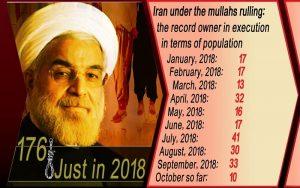
Iran is a prime example of such a mentality. By scratching the surface and getting a little deeper, for Iran’s rulers, it is not just a mere form of punishment. It is an instrument of spreading fear among the citizens. Even China, with a population 17 times larger than Iran, and a world’s leading advocate of the death penalty, there is hardly any case of public hanging or juvenile execution.
: under the despotic rule of brutal ayatollahs has the highest number of executions in the world proportionate to its population
In the case of mullahs in Tehran, execution is a means to an end. It is only used to keep in check the fed up citizens, it is a reminder that dissidence will have dire consequences. The regime has tried throughout its life to sugarcoat and sell it to the rest of the world as a noble contribution in the fight against drug smugglers.
In Iran, people are executed by the state as punishment for a variety of crimes – sometimes for acts that should not be criminalized. Hundreds are hanged for non-violent drug offenses. This day should involve Iranian regime who have not abolished the death penalty. Iran has the highest rate of executions per capita in the world. The officially announced total number of executions during Rouhani’s tenure has reached 3,602 cases.
According to HRM website: “Since January 2018, at least 223 people have been executed. The executions of at least nine political prisoners and six individuals who were under 18 at the time of the crime have been confirmed. 35 executions were carried out in public.”
Nevertheless, the true figures are definitely higher as most executions in Iran are carried out in secret.
A large number of defenseless prisoners are covertly executed in jails across the country and thousands of others are on death row.
Rouhani has specifically said these executions are “either based on God’s laws or the legislation adopted by the parliament… and we are merely implementers.”
Executions, torture, stoning, amputating hands and feet, and gouging out eyes are institutionalized in Iran and literally legalized by this regime’s so-called laws. Executions in Iran have become means to crack down on people’s freedoms and quell social protests.
We call on all human rights organizations and advocates to impel the mullahs’ regime to bring an end to executions in Iran.
We want an Iran free of the death penalty. The abolishment of the death penalty must include Iran, and Iranian people should not be sentenced to death by a regime which uses this punishment to prolong its rule.

Friday, 21 September 2018

IRAN’S HUMAN RIGHTS SITUATION IS WORSENING


The Secretary General of the United Nations has released his latest report on the situation of human rights in the Islamic Republic, and the Center for Human Rights in Iran published excerpts of that report on Tuesday, ahead of its presentation to the UN General Assembly in New York.
The report gives credit to Tehran for engaging with the international community and taking “positive steps” such as a revision in drug laws that reduced the frequency of the death penalty for non-violent offenses.
But the main substance of the report is a catalogue of familiar human rights abuses that have not been addressed, followed by associated recommendations for changes in the behavior of the Iranian regime.
Notwithstanding the Secretary General’s more optimistic remarks, there is no real indication that the regime will be more responsive to these recommendations that it has been on any of the prior instances in which they were brought up in the context of previous reports from the Secretary General, the UN special rapporteur on human rights in Iran, and others.
Indeed, with respect to a number of human rights issues, the regime has struck a defiant tone in dialogue with the international community. And regardless of recent changes in drug laws, the death penalty ranks high among these issues.
On Sunday, the Iran Human Rights website reported upon the latest instance of the Iranian judiciary refusing to abide by the changes in its own laws when it carried out the execution of another person who had been convicted of drug trafficking without any violent offense.
The report points out that at least three other such individuals have been put to death since the change took effect last November. It should also be noted that there could be others besides, since executions frequently go unreported by Iranian authorities and are added to the record of killings only later, after activists and fellow prisoners reveal the information to independent monitors.
Nevertheless, it does appear to be the case that the number of drug-related executions has sharply declined in the past year. Yet this is only one part of the Iranian regime’s relationship with the death penalty that has traditionally opened it up to international criticism.
The persistent execution of juvenile offenders is another and it involves disregard for international human rights conventions to which Iran is a signatory. On this point, the regime has shown no inclination toward compromise, and the latest figures suggest that the number of these killings may actually be on the rise.
According to another Iran Human Rights report, at least five Iranian prisoners were executed in 2017 for crimes that had allegedly committed when they were below the age of 18. This year, at least three such individuals were executed in the month of January alone.
And apart from implementing juvenile death sentences that have been imposed in years past, the Iranian judiciary also continues to pass more such sentences, even in the face of wide-ranging international condemnation and activism.
Most recently, an individual identified only as Mehrdad had his sentence revised up by the Criminal Court of Tehran, which imposed the death sentence in place of a sentence of imprisonment and the payment of blood money for the 2014 murder of a fellow teenager whom Mehrdad accused of sexually assaulting him.
This represents a trend in the exact opposite direction as the international community has sought to push the Islamic Republic in the past. At various times, the judiciary has delayed the execution of juvenile offenders and ordered the reexamination of the case under international pressure, but in almost every case the courts then upheld the sentence and affirmed their right to impose the ultimate sentence on anyone who is deemed sufficiently mature. Under Iranian law, such a person may be as young as nine.
The latest executions and death sentences stand out as qualifications to the “positive steps” highlighted by the United Nations. Meanwhile, the Secretary General’s report goes a long way on its own toward downplaying that praise, insofar as it acknowledges that the Islamic Republic is in the midst of a severe crackdown on dissent, accompanied by human rights violations and a sharp increase in censorship.
There is no shortage of media reports to highlight this trend, which has certainly been ongoing since the mass uprising that took place in late December and early January, and arguably ever since the election of President Hassan Rouhani and the start of nuclear negotiations between Iran and six world powers.
According to the National Council of Resistance of Iran, security forces arrested upwards of 8,000 peaceful protesters in the midst of the mass uprising, as well as shooting approximately 50 dead in the streets and allowing a dozen others to die under torturous interrogation.
Anti-government protests have continued in spite of this repression, but the repression itself has also broadened to include known activists who may not have personally participated in the initial uprising.
On Tuesday, Iran Human Rights Monitor reported that Soha Mortezaie, the Secretary of the Central Guild Council at Tehran University, had been sentenced to six years in prison plus a two year ban on political activities simply for inquiring after the status of student protesters who were arrested in the midst of the nationwide demonstrations.
The same report identified 21 such students who have already been sentenced for protesting. Their sentences range from one year to a staggering 12 years in prison, and numerous other prisoners remain either in jail or free on bail pending their own sentencing for the same activities.
While the uprising was in full swing, judiciary officials publicly warned that those who were identified as leaders of the protest movement could be subject to the death penalty.